

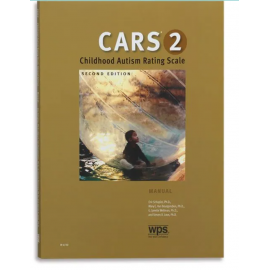
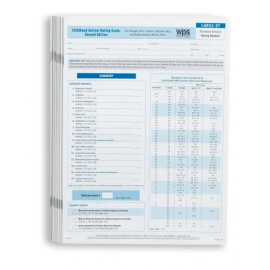
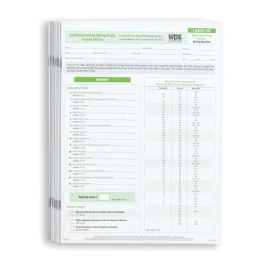

(CARS®2) Childhood Autism Rating Scale, Second Edition

Product Description
Benefit
Helps to identify children with autism and determine symptom severity through quantifiable ratings based on direct observation
Translation
Available in Bulgarian & Italian
Published Translations
Scores
Cutoff scores, standard scores, and percentiles
Format
Two 15-item rating scales completed by the clinician (each designed for a different population); and an unscored Parent/Caregiver Questionnaire
Admin Time
5–10 minutes (after the information needed to make the ratings has been collected)
Ages
2 years and up
Publish Date
2010
Qualifications
Level C required.
Since its original publication, the CARS has become one of the most widely used and empirically validated autism assessments. It has proven especially effective in discriminating between children with autism and those with severe cognitive deficits, and in distinguishing mild-to-moderate from severe autism.
The revised second edition expands the test’s clinical value, making it more responsive to individuals on the “high-functioning” end of the autism spectrum—those with average or higher IQ scores, better verbal skills, and more subtle social and behavioral deficits. While retaining the simplicity, brevity, and clarity of the original test, the CARS2 adds forms and features that help you integrate diagnostic information, determine functional capabilities, provide feedback to parents, and design targeted intervention.
The CARS2 includes three forms:
Standard Version Rating Booklet (CARS2-ST)
Equivalent to the original CARS; for use with individuals younger than 6 years of age and those with communication difficulties or below-average estimated IQs
High-Functioning Version Rating Booklet (CARS2-HF)
An alternative for assessing verbally fluent individuals, 6 years of age and older, with IQ scores above 80
Questionnaire for Parents or Caregivers (CARS2-QPC)
An unscored scale that gathers information for use in making CARS2-ST and CARS2-HF ratings
The Standard and High-Functioning Forms
The CARS2-ST and CARS2-HF each include 15 items addressing the following functional areas:
- Relating to People
- Imitation (ST); Social-Emotional Understanding (HF)
- Emotional Response (ST); Emotional Expression and Regulation of Emotions (HF)
- Body Use
- Object Use (ST); Object Use in Play (HF)
- Adaptation to Change (ST); Adaptation to Change/Restricted Interests (HF)
- Visual Response
- Listening Response
- Taste, Smell, and Touch Response and Use
- Fear or Nervousness (ST); Fear or Anxiety (HF)
- Verbal Communication
- Nonverbal Communication
- Activity Level (ST); Thinking/Cognitive Integration Skills (HF)
- Level and Consistency of Intellectual Response
- General Impressions
Items on the Standard form duplicate those on the original CARS, while items on the High-Functioning form have been modified to reflect current research on the characteristics of people with high-functioning autism or Asperger’s Syndrome.
The clinician rates the individual on each item, using a 4-point response scale. Ratings are based not only on the frequency of the behavior in question, but also on its intensity, peculiarity, and duration. While this more nuanced approach gives you greater flexibility in integrating diagnostic information, it still yields quantitative results.
The Rating Booklets for both the Standard and High-Functioning versions are particularly convenient. They include space for clinical note-taking and documentation. They briefly describe each area rated, providing a reminder of rating criteria and a framework for explaining results to parents. And they list cutoff values so that you can see at a glance whether further evaluation is warranted.
Rating values for all items are summed to produce a Total Raw Score. Each form includes a graph that allows you to quickly convert the Total Raw Score to a standard score or percentile rank (based on a clinical sample of 1,034 individuals with autism spectrum disorders). The Manual provides guidelines for score interpretation, suggestions for intervention, and case examples.
The Questionnaire for Parents or Caregivers
The CARS2-QPC is an unscored form completed by the parent or caregiver of the individual being assessed. Its purpose is to give the clinician more information on which to base CARS2-ST or CARS2-HF ratings. Often the questionnaire serves as the framework for a follow-up interview, during which the clinician can clarify and interpret the responses provided by the parent or caregiver.
The areas covered by the CARS2-QPC include the individual’s early development; social, emotional, and communication skills; repetitive behaviors; play and routines; and unusual sensory interests.
The Best Way to Inform and Support Diagnosis
The CARS2 is extremely useful in identifying symptoms of autism.
- It covers the entire autism spectrum, as defined by empirical research.
- It is based on decades of use with thousands of referred individuals.
- It assesses virtually all ages and functional levels.
- It provides concise, objective, and quantifiable ratings based on direct behavioral observation.
- Scores show a consistent, strong, positive, and specific relationship with an autism diagnosis.
- Ratings are reliable across time, settings, sources of information, and raters.
With a new form for higher functioning individuals, a structured way to gather caregiver information, and guidelines linking scores to intervention, the CARS2 remains one of the best autism assessments available.
Terms Often used to search for (CARS™-2) Childhood Autism Rating Scale™, Second Edition
Childhood Autism Rating Scale, cars 2 autism, childhood autism rating scale second edition, pdf, scoring, test, report
| W-472 | CARS-2 Kit | Email for quotation |
| W-472A | CARS-2 Standard Version Rating Booklet (Pack of 25) | Email for quotation |
| W-472B | CARS-2 High Functioning Version Rating Booklet (Pack of 25) | Email for quotation |
| W-472C | CARS-2 Questionnaire for Parents or Caregivers (Pack of 25) | Email for quotation |
| W-472D | CARS-2 Manual | Email for quotation |
When you order from google.com, you will receive a confirmation email. Once your order is shipped, you will be emailed the tracking information for your order's shipment. You can choose your preferred shipping method on the Order Information page during the checkout process.
The total time it takes to receive your order is shown below:

The total delivery time is calculated from the time your order is placed until the time it is delivered to you. Total delivery time is broken down into processing time and shipping time.
Processing time: The time it takes to prepare your item(s) to ship from our warehouse. This includes preparing your items, performing quality checks, and packing for shipment.
Shipping time: The time for your item(s) to tarvel from our warehouse to your destination.
Shipping from your local warehouse is significantly faster. Some charges may apply.
In addition, the transit time depends on where you're located and where your package comes from. If you want to know more information, please contact the customer service. We will settle your problem as soon as possible. Enjoy shopping!